42.3%
of households in Headingley & Hyde Park live in a terrace, the most in the city, ahead of Gipton & Harehills at 41.6%.
An independent guide for Leeds homes
A quarter of Leeds households live in a terrace, and many of those are back-to-backs that own just one side of their roof. A semi in Roundhay and a back-to-back in Harehills face different questions before price even comes up. This guide works through them with Leeds figures, each one sourced.
Figures checked 3 November 2026 · Published independently by SEO-DONS LTD
Leeds homes, by type
Roof picker · PVGIS for twelve Leeds points
On a Leeds terrace the slope you can use depends on the house type as much as the compass. Choose yours. Figures are PVGIS 5.3 estimates for a 35° roof with 14% system losses: a fair comparison, not a survey.
Best slope you own, a year
2,682 kWh
Source: PVGIS 5.3, European Commission JRC, pulled 3 November 2026; prices: DESNZ 2025/26 Yorkshire and the Humber means (our arithmetic). Nearby buildings, trees and chimneys are not included.
Research at the University of York describes Leeds's back-to-backs as the largest surviving group of the type in the UK (Harrison, 2019), and council housing evidence puts the number still in use at about 19,500 (Leeds City Council). Each house shares its back wall with another that faces the next street, so the ridge of the roof runs along that shared wall and each house owns the slope above its own front door.
That makes the street's direction the whole story. On a terrace running east to west, the houses on the north side of the street have south-facing slopes, about 947 kWh a year per kW in Harehills on PVGIS figures, while their neighbours across the ridge face north and would get about 505. On a north–south street, every house gets an east or a west slope, roughly four-fifths of a south roof.
Back-to-back roofs are also small, often broken by chimney stacks and dormers, so arrays are modest. The back-to-back guide covers sizing, access in narrow streets and what a shared chimney means for the layout.
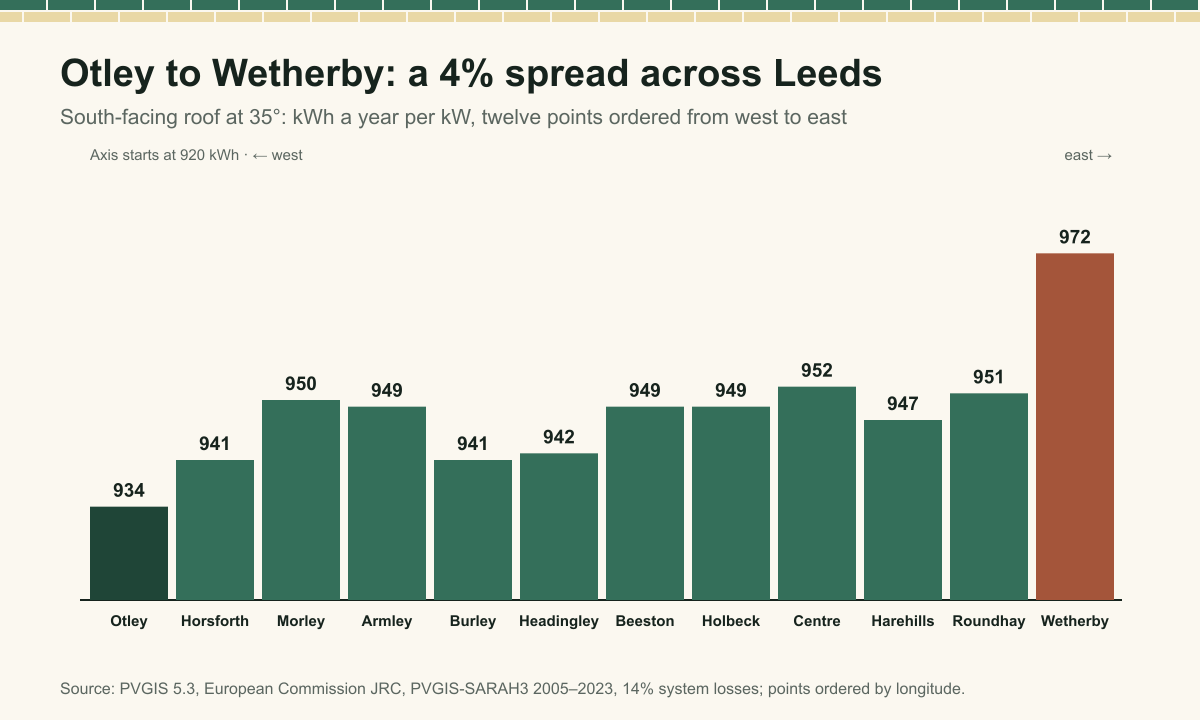
The district stretches from the edge of the Pennines to the Vale of York, and the roof figures follow. PVGIS gives a south-facing roof 934 kWh a year per kW at Otley, 952 in the city centre and 972 at Wetherby (PVGIS 5.3). At the best angle, the city centre reaches 956.
The weather records point the same way. The Met Office's long-term averages come from stations around the city: at Church Fenton, east of the district, the 1991–2020 averages are 1,525 hours of sunshine and 620 mm of rain a year, while Bingley, up the Aire valley to the west, records 1,057 mm of rain on 156 days (Met Office, Church Fenton; Bingley).
Even the wetter west makes useful power: panels work on daylight, not just direct sun. Is Leeds sunny enough?
At the 2021 Census, 37.5% of Leeds households lived in a semi, against 31.5% across England, and 25% in a terrace (ONS). Where they live differs sharply by ward.
42.3%
of households in Headingley & Hyde Park live in a terrace, the most in the city, ahead of Gipton & Harehills at 41.6%.
57.8%
of households in Moortown live in a semi; Killingbeck & Seacroft is higher still at 59.3%.
56.8%
of households in Little London & Woodhouse live in a purpose-built flat, where the freeholder decides about the roof.
41.5%
of households in Wetherby live in a detached house, with roofs of their own to use.
Terraces and semis · Shared houses and flats · New-build homes
Government figures for 2025/26 cover 18,822 MCS-certified installations in Yorkshire and the Humber. The average was £1,972 per kW for systems up to 4 kW and £1,745 per kW for 4 to 10 kW (DESNZ). Smaller systems cost more per kW because scaffold, the inverter and the paperwork are much the same whatever the size, which matters on small back-to-back roofs.
VAT on installed solar is 0% until 31 March 2027 and 5% after (HMRC), so a £6,000 job would carry about £300 of VAT from April 2027, by our arithmetic.
| Size | Average per kW | About | kWh a year |
|---|---|---|---|
| 3 kW | £1,972 | £5,900 | 2,856 |
| 5 kW | £1,745 | £8,750 | 4,760 |
There is no solar grant in England for households that can pay; the government's Warm Homes Plan offers them loans instead (Warm Homes Plan). For those who qualify, Leeds City Council's Warm Homes: Local Grant lists solar panels, and batteries fitted with them, among its measures. It is for privately owned homes, lived in by the owner or let privately, at EPC band D to G, where household income is under £36,000, someone gets an income-related benefit, or the home is in a qualifying area (Leeds City Council).
When we checked, the scheme was not taking new applications because of demand; it runs until March 2028, and the council says it may reopen after a review from April 2027 (Warm Homes Leeds). The EPC test also rules out half the city: 49.7% of Leeds homes with a certificate are already band C or better (ONS).
Every household can sell spare power: larger suppliers must offer an export rate under Ofgem's Smart Export Guarantee rules, each setting its own (Ofgem). The funding guide
Panels on a house roof in England are permitted development within limits set out again on 27 August 2026 (SI 2026/896). Leeds has 80 conservation areas, where the council notes that permitted development rights are restricted and some solar panels need permission (Leeds City Council), and Historic England lists 2,368 entries in the district, 46 of them Grade I (Heritage Counts). A listed building always needs consent.
Northern Powergrid owns the network across Leeds. Under G98, a system up to 16 amps per phase, 3.68 kW on a single-phase supply, is connected by the installer and notified within 28 days; batteries count towards that, and larger systems apply first under G99 (Northern Powergrid).
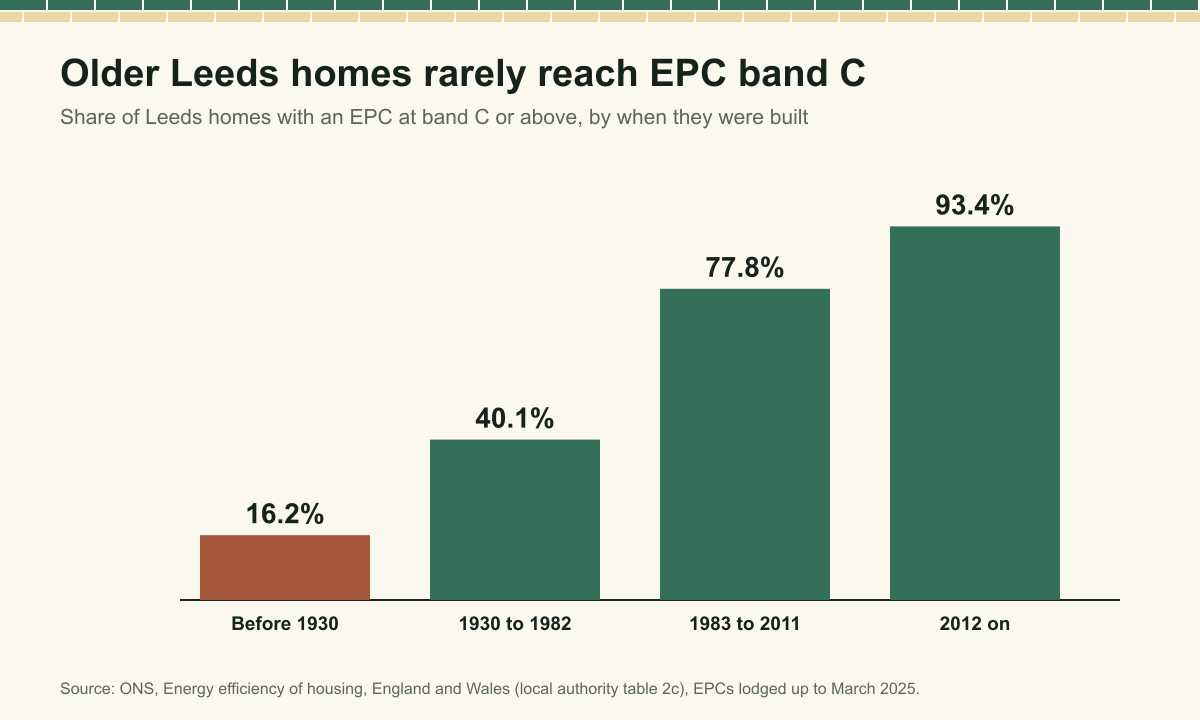
17% of the 380,690 properties on the Leeds council tax list were built before 1919 and 18.6% between the wars (VOA 2026). Only 16.2% of Leeds homes built before 1930 reach EPC band C, against 93.4% of those built in 2012 or later (ONS).
Panels generate just as well on an old roof as a new one, and they improve the rating. But in a solid-walled terrace, insulation and draught-proofing usually do more for the heating bill, and the council's grant works through the whole house in that order.
This guide fits nothing and recommends no firm. Check any installer yourself: MCS certification, membership of a consumer code such as RECC or HIES, a written itemised quote and a protected deposit.
Leeds gets a reasonable amount of sun for a northern city. PVGIS gives a south-facing roof about 952 kWh a year per kW in the city centre, rising to 972 at Wetherby. Whether panels suit you depends on the slope you own, shade and when you use electricity.
Usually, yes, but only on the one roof slope the house owns: the side above its own front door. If that slope faces north, the panels will make about half of what a south slope would, so check the direction first with the roof picker.
Usually not for panels on a house roof within the national limits. Listed buildings need consent, and in Leeds's 80 conservation areas some solar equipment, such as panels on a wall facing the road, needs permission.
Leeds City Council's Warm Homes: Local Grant lists solar panels, but only for privately owned homes at EPC D to G with a qualifying household (income under £36,000, a means-tested benefit, or a qualifying area). When we checked it was not taking new applications. Everyone pays 0% VAT on installed solar until 31 March 2027.
Northern Powergrid runs the Leeds network. Systems up to 3.68 kW on a single-phase supply are connected by the installer and notified within 28 days (G98); larger ones need the network's agreement first (G99).
Say which part of Leeds you are in, what kind of house it is and what you want to work out. The message reaches SEO-DONS LTD, who publish this Leeds guide, and the answer comes by email. Nobody visits or phones, and there is no charge.